
Purpose-fit GPU Compute
Design accelerator, CPU, memory and storage resources around training, inference and data processing needs.
Create a secure foundation for real-world AI in India. From on-premises GPU servers to private cloud and hybrid environments, we design scalable infrastructure around your workloads, data and governance priorities.
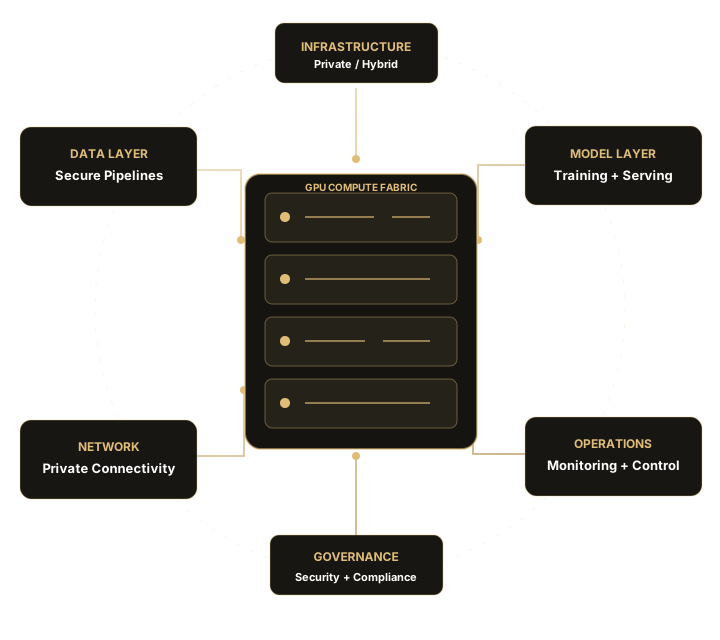
AI infrastructure should make production deployment easier, give teams confidence and keep technology aligned with business outcomes.
Design accelerator, CPU, memory and storage resources around training, inference and data processing needs.
Keep permissions, data movement and private system access central to your architecture decisions.
Build repeatable deployment patterns that can grow from an early pilot to multiple production workloads.
Plan monitoring, lifecycle controls and workload observability from the start—not after go-live.
Compare how the same intelligence can be deployed on-premises, in a private cloud or across a hybrid environment.
Deploy dedicated GPU compute close to business-critical data, with your team retaining direct control over access, networking and lifecycle.
Useful when data locality, predictable access and internal governance drive the architecture.
Illustrative architecture layers · Not A Hardware Specification
Three quick choices. One useful starting point for discussing an AI server architecture in India or for distributed teams.
Select the project context and see an indicative architecture direction update instantly.
This is a qualitative design guide, not GPU sizing, a price quotation or a capacity guarantee.
Model Serving
Optimize response consistency and governance as usage grows.
From private AI assistants to computer vision, the right infrastructure depends on how intelligence will be used in production.
Infrastructure patterns for private inference, model evaluation and responsive enterprise AI applications.
Run orchestration services that connect models, tools and business systems within clear guardrails.
Combine document processing, indexing, retrieval and secured access to enterprise knowledge.
Support image pipelines and inference workloads across inspection, classification and analytics.
Connect data preparation, model workloads and monitoring for forecasting and decision support.
Connect AI workloads to ERP, CRM, databases and APIs without losing governance and context.
Infrastructure is a system, not just a server. Our approach considers applications, data, performance and ownership together.
Understand workloads, data sensitivity, performance expectations and existing IT foundations.
Define GPU compute, storage, connectivity, access controls and deployment topology.
Connect model serving, data pipelines, systems and observability into usable workflows.
Review model performance, utilization, governance and evolving infrastructure requirements.
Practical guidance on AI servers, GPU infrastructure and deployment decisions for enterprises in India.
AI servers are designed for compute-intensive tasks such as model training and inference. GPU acceleration, high-throughput memory, storage and networking are typically considered together, rather than sizing only for conventional web or database workloads.
Yes. An on-premises architecture can be considered when an organization needs direct control over its data, access policies and compute environment. Hardware sourcing, site readiness, support and data policies should be reviewed during the design stage.
The infrastructure design can cover private LLM inference, retrieval-augmented generation (RAG), document processing and AI agents. The recommended architecture depends on model size, concurrency, latency and data governance needs.
Choose based on data sensitivity, cost profile, demand variability, existing operations and deployment speed. On-premises can fit tightly governed or steady workloads; cloud can be suitable for variable demand; hybrid combines the two.
Sizing begins with the workload and target model, then considers memory requirements, concurrency, throughput, data volumes, storage, networking, security and availability. A proof of concept and load tests should validate any proposed capacity.
Yes, through carefully designed APIs, data pipelines, authentication and permission checks. Data access and integration patterns are reviewed before a model is connected to enterprise applications.
Discuss your application, data environment and infrastructure requirements with Nuclear Infotech. Start with the architecture, not a list of hardware.